Business, DIY, Home, Marketing, Society

Slow News Days

Press

Image by Alexas_Fotos from Pixabay

I haven’t got much to say today so I’ll quickly mention newspapers that seem to be similarly afflicted.

Linda Smith once said on a B-series episode of QI “My favourite ever headline was “Worksop Man Dies Of Natural Causes.”

The internet era equivalent of the Worksop man are the people from across the country who have done some DIY on a budget. The Google News feed on my phone provides me with, at least once a week, a story from a local newspaper site wherein someone has given their kitchen, bathroom or garden a spruce up for less than it should surely cost by doing something novel and amazing – buying things from a cheaper shop. Gasp.

They’re generally along these lines: “Savvy shopper Tracy transformed her home using items from [insert bargain store name here]“, and the article tells us “she got a new look kitchen for just £200.” Sometimes you’ll “never believe how she did it.”

Why is this news? Why is it unbelievable? Why haven’t I got an article written about me? Just last night I had fish, chips and mushy peas for less than the chip shop cost by buying items from Asda and B&M Bargains. Chips shop quality mushy peas too. And I’ve given my living room a makeover using stuff from B&M and Ebay no less.

When there’s a two-hundred foot UFO hovering over the town hall, that’ll be news.

[Glances out the window, just in case.]

Standard
Gadgets, Meta, Tech

Paper Versus Pixels

Notebook

Image by Free-Photos from Pixabay

It has often been noted that ideas bubble up in the mind at inconvenient times: in the shower, on the toilet, when you’re just dropping off to sleep – it’s usually when your brain has few distractions, but it’s also when you’re often nowhere near anything electronic to make a note of them. I use Evernote to organise ideas and drafts for this blog and as I’m too stingy to pay the monthly subscription I can only use it on my desktop and laptop PCs, at home. Therefore when I think of something for a post I have to write it on a post-it note and I then end up with a small but colourful collage of three-inch squares of paper stuck to the desk.

The same is true of to-do lists and things to remember and shopping lists.

Before smartphones existed I had a Windows Mobile equipped PDA (Personal Digital Assistant, or Personal Organiser) which still failed to organise my life, through no fault of it’s own. More recently I’ve tried again, using apps on the phone and tablet but find that I tend to forget that I’ve put it on there whereas a piece of paper sits there, waiting to be dealt with, visibly. I have found the reminders useful though. I am tired of the clutter however so I’m going back to what I used to do before trying to go digital and using a single notebook that I can keep open on the desk to jot anything down on whether the computer is on or not and if I do use a random piece of paper – if I’m not at home when inspiration hits me round the chops for example – I can transfer it to the book when I get home and bin the scrap instead.

For some reason I’ve also found that if I have a list of titles, or brief ideas, for posts in a notebook I can flick through them and gain inspiration better than doing the same in Evernote.

I’ve had A4 and A5 spiral bound books before but now I’ve treat myself to a nice A5 six-ring binder as when I’ve typed up the notes I can remove the pages and bin them. I know I could do that with a spiral book but as I’ve said before I appreciate nice stationery and the posh binder looks neater on the desk, or on the tv unit in the living room.

I know that today I could even simply say “Hey Google add milk to shopping list” or “take a note…” so there’s not even any typing involved but somehow I just prefer actually writing the thought down, and anyway the virtual stenographer in a box would simply file the note away where I would forget about it again. Similarly, when it comes to reminders being able to just ask Google to set one up is handy. As for shopping lists I tend to use a basket and hold the list with the same hand as the handles so using my phone would be more of a problem anyway. When, one day you can make the Google assistant keep asking you, as you’re doing shopping “have you got the milk?” “Yes Google.” “What about the pasta sauce…” then it might be useful, or maybe not.

Beyond my inability to remember that Google Keep, or Microsoft Todo exist the paper notebook has the same advantages as a paper novel – it needs no batteries, it doesn’t have to boot up or sync with a server and as such it’s instantly accessible, as long as you’ve also got a working pen handy. Maybe this is why thirty-odd years since they became the yuppies’ trendy accessory-du-jour the Filofax is still with us.

Standard
Business, Marketing, Society

A Tale of Two Ciders

Cider

Image by StockSnap from Pixabay

It’s a Friday night in summer, half-past-eight and I’m listening to Jazz, watching the sunset and drinking a glass of Cider. It is one of my great pleasures.

Cider used to be simple, it was an alcoholic drink made from Apples, but as with so many things now it has to have more variety to appeal to wider markets so now there are Raspberry Cider, Strawberry Cider and so on. They’re not Cider. In a shop once the man stood near me said into his phone “They’ve got a Pear Cider kit mush, just wondered if you want one,” “it’s not Cider, it’s Perry” I muttered under my breath. There used to be Sweet Cider and Dry Cider, and the likes of Scrumpy, but you still got progressively pissed, or merry at least, just at a different rate. And it all tasted of Apple.  Apparently even in France Cider has to be made entirely of Apples.

Our American friends have muddied the scrumpy even more with Apple Cider and Hard Cider – the first being pure Apple Juice (it isn’t Cider, yet) and the latter is, let me think, CIDER.

As a result of the different flavours my favourite brand of English Cider now has Apple Cider on the label, though it might surprise any Americans who were expecting a soft drink.

To take this to its ultimate conclusion will the famous novel featuring the drink in the title, in future, be renamed “Hard Cider with Rosie”?

Standard
Society, Transport

But Cyclists Don’t Pay Road Tax…

Bicycle

Image by Free-Photos from Pixabay

I enjoy driving yet I am currently on bike number five but car number four, I did, however start on bikes when I was at school – a Raleigh Striker, then an orange Grifter, then an Emmelle Alpine in white and green which I had with me until I moved to the centre of Newark, left it chained up outside and some nice person decided they’d prefer to relieve me of it and sell it for scrap for a few quid, after all why would I miss it, it’ll be insured, I could replace it, etc, the usual thieves excuses. I was gutted, angry. I replaced it for practical reasons with a folding mountain bike that I had to carry up three flights of stairs to store outside my apartment. When I moved again to where I had a nice secondary section of garden where my dad built me a bike shed to store it securely I took the opportunity for a change, to replace the folder which was too small and caused my back problems just from riding it with a suitable replacement for the Alpine.

I now have a really nice mountain bike having traded in my old one and being the right size is a pleasure to ride, I recently even realised that my new Orange bike is perhaps a subconscious homage to my earlier bike.  I’ve recaptured the enjoyment of cycling I had years ago.

Mostly.

Here are a couple of myths some people seem to believe: Cyclists don’t pay road tax, and cyclists are obliged to stop and get out of the way of cars when the car is on the cyclist’s side of the road because the car always has right of way.

I pay road tax on the car I can’t use during the week even if I wanted to because the fuel isn’t cheap and there’s nowhere to park at work, mainly because of people parking in the work car park who shouldn’t be there but assume that because it’s next to their houses without off-street parking they’re entitled to use it.

The other myth is something I encounter every day – on a street where along one side is residents’ parking that leaves the rest as a two-way single carriageway road. According to the highway code I have right of way when I’m passing the line of parked cars, especially when I’m on the correct side of the road for my direction of travel yet whenever a car comes the other way on what would be the wrong side of the road from their perspective they just come barrelling towards me and expect me to get out of the way, one idiot in a BMW was actually grinning and drove deliberately at me.

Which brings me to the other point – people seemingly finding it amusing to drive too close to cyclists and cutting us up at junctions – this happened where a car passed me and immediately swerved at speed across in front of me into a junction on my left I was approaching, just as I was thinking that was close the Transit van which was following the car did the same, I had to brake sharply, thanking Halfords that the bike had great disc brakes, I’d only had the bike four days. The thing is that it seems fashionable to hate cyclists and this fashion has become like a game to some drivers, like it’s expected to do your part in driving cyclists off the road by intimidation. As I mentioned earlier such drivers find it funny and so many drivers just seem to think that cyclists don’t belong on roads, hence the Road Tax reference.

I admit that many cyclists annoy me, the weekend tour-de-Nottinghamshire peleton wannabes riding in a three or four-wide pack on high-speed roads rather than single-file as instructed in the Highway Code for example, or the lads I saw once who ignored any traffic signals and shot across a busy four-way junction in front of two lanes of moving traffic, almost causing a pile-up. Then there are the ones who, perhaps on principle, won’t use cycle lanes where provided.

As a car driver and cyclist I see both sides and try to be considerate in both situations, for example while taking my government sanctioned daily coronavirus lockdown exercise I was aware of firstly a lorry behind me on a narrow road in the town and another time a car behind me on a country road. Both times I quickly found a safe place to pull off the road briefly and let them go past and both drivers waved thank you too.

There are some cyclists who ride stupidly, there are some motorbikers who do the same, there are some drivers who drive stupidly too. It’s not fair to tar everyone with the same brush.

Standard
Business, Tech, Transport

Keeping Track

Parcel

Image by Harry Strauss from Pixabay

I wrote a number of posts a few years back about parcel deliveries in this country, but I’m pleased to see that now things have improved immensely.

One area that is impressive is how parcels can now be tracked more precisely than ever. I recently bought some sunglasses that fit over my normal glasses and the only ones that suited were located in the United States. I ordered them and the cost in total including shipping was just under £12, for that this item would travel part way across the US, then the Atlantic and finally up the UK to me. Monitoring the tracking the item moved around the postal network until it popped up in Illinois, finally arriving at Chicago before being loaded onto a plane for an overnight flight to London where it met our postal system.

Even more precise is the system used by Amazon for example that allows, via their phone app, notifications of how near the driver is away from you on a map, so you know that they’re five stops away, on a nearby street so you know not to go out or go in the bath, or to dash back to your house when you’ve just nipped out to the corner shop – maybe the app should have a button that says “just tell the driver to hang on two minutes…”

All this of course is made possible by GPS location tracking and handheld scanners that can communicate with the company so they know in real time where the vans are, and on what van your parcel is sitting. One strange aspect to this is another courier whose drivers are not allowed to deliver a parcel too early, though I’m sure there’s a good reason for this, something to do with them giving customers time slots for delivery. In business knowing when a parcel is going to arrive to within a specific one-hour time slot can help schedule work.

I do find myself occasionally saying, when I get a message from the same tracking system to inform me that the parcel’s been delivered, “I know, I received it, it’s in my hand.”  Still useful to know if you’re not home though.

All this tracking and technology has been helpful in these days of social distancing and contactless delivery where the courier doesn’t take a signature but uses the handset’s camera to show it where they left it on the doorstep instead, usually with your feet in the background – “we know you received the parcel, are those or are those not your socks?”

I’m rarely in a hurry for items, I remember the days of “please allow 28 days for delivery” so next day is a luxury, but it’s still interesting to see the data, to see where it’s been and I suppose it’s still exciting when it’s something nice or frivolous rather than functional to see when it’s close to being delivered.

Standard
Cats, Nature, Outdoors, Tech

The Technocats

Ginger Cat

Image by Daga_Roszkowska from Pixabay

For a long time cats have chosen a suitable Human to live with and we’ve either had to let them in or out of our houses on demand, left a window open or otherwise made a small hole in our back doors and fitted cat flaps.

These were fine of course until our cat was followed by other cats into the house, or other cats, being naturally curious and hungry decided to see if there was anything to eat behind this strange little door.  As such the lockable door was invented but still required Human intervention – usually at night.  The option to have the door set to out-only or in-only was unusual as I’m sure the cat would wonder why it had been suddenly trapped indoors, or locked out.

Next came the wonderfully humourous magnetic cat flap.  Our cat had this and we were only one family in many who witnessed their moggy returning home with some random metallic object dangling from its collar and a bemused look on its face.  Short of amassing a small collection of random screws they never brought back anything valuable though.  The other side effect that took some getting used to was when the cat walked too close to a radiator and dragged the magnet clattering along it’s length, usually at two in the morning, downstairs.

Recently though the rise of microchipping of cats for identifying lost pets by vets has created the smart cat flap, the feline equivalent of a hotel key-card, only allowing authorised cats through.  The problem, from the cat’s point of view used to be the magnet not releasing the door quickly enough when in a hurry, resulting in a frantic clattering of the door until the cat’s releasing of the flap coincided with the releasing of the latch.  I imagine the same situation with the chip flaps would be like having to repeatedly swipe a chip and pin card at the supermarket, forward and back in front of the door.

So technology moves on, making things better, but it’s still not as funny as a cat strolling into the room with a spoon attached to its collar and an expression on it’s face along the lines of “what?”

Standard
Society

Dirty!

Soil & Trowel

Image by walkersalmanac from Pixabay

I was thinking yesterday that at the weekend I’m going to clean the bird muck off the top of my wheelie-bin as although the bin men and women no doubt see all kind of muck it’s not nice to have to deal with.

This reminded me of the state of uncleanliness that some people are happy to present their possessions in when leaving them with someone else – for repairs, alterations, inspections and so on.

I have worked in two places where I can give examples.  There was once an infamous motor-home taken to a dealership for its annual service.  This was an expensive van, top of the range and when the technician opened the habitation door he felt the need to let even us in the warranty office see it.  The carpets looked like they were 90% dog hair, the air was 90% dog breath, or at least, er, aroma.  The corners and edges of cabinets had been gnawed, hopefully by the dogs and we could only imagine what potentially coated the rest of the surfaces.

Then there’s a regular occurrence whereby someone will bring in a piece of greenhouse glass into the shop to be cut down to replace a broken piece, rather than buy a new, shiny piece.  We don’t mind doing this but it’s inconvenient when the piece they bring in has been sat behind the greenhouse for two decades and has built up a significant, shall we say, patina.  Usually it’s springtime so the moss and soil on the glass will be damp and we have to clean it off before we can use our glass cutters on the glass itself – if not we’d end up with clogged cutters and soggy cutting table.

Personally I couldn’t do that, even if I take items to a charity shop I clean them whether it is a t-shirt or a photo frame, I tidy the car before taking it for an MOT.  As for my bin, well maybe even the cat that likes to sit on it in the sunshine might appreciate it being cleaner too.

Standard
Architecture, Outdoors, Psychology, Society

The World Wrapped in Cotton Wool

Warning Signs

Image by Peter H from Pixabay

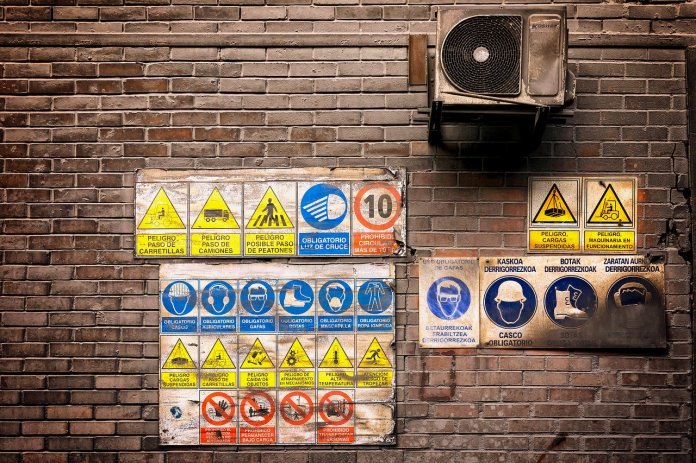
In recent years, it seems to me, our urban architecture has turned into a sea of yellow and red warning signs and yellow and black striped tape.

Today there seems to be a constant corporate fear of being sued that has caused so much of this kind of protectiveness. For example the Royal Mail depot near me has big warning signs at the site entrance warning of a “Trip Hazard” which may be the ends of the lowered pavement where public pedestrians are corralled between railings towards where they collect parcels. Where this public path intrudes onto the roadway a big yellow line and accompanying signage tells the humans to not stray outside the lines lest they be flattened by Postman Pat’s little red van. There are further trip hazard signs and yellow and black tape at the actual entrance to the collection office as despite there being a ramp to one side the straight ahead approach involves negotiating, unbelievably, a normal height step. OMG, get me some climbing gear. Despite all this there are still the big signs saying “Beware of Vehicles”.  When I was young we were taught the Green Cross Code to follow when near roads.

Another example of the idea of “you didn’t do enough to stop me injuring myself” are scaffolding poles – “now padded for your safety and comfort” and also wrapped in yellow and black tape. I wonder whether it was a ploy to support the manufacturers of tubular yellow foam products, maybe they weren’t selling enough as pipe lagging but at some point in the last fifteen years it was decided that every bit of publicly accessible scaffolding needed legwarmers. On pavements the world over there are lampposts, street signs, litter bins, bollards, walls and even doorsteps or whole sections of buildings jutting out into the path of pedestrians yet none of those things are padded for your protection, or edged with wasp-coloured tape. You can’t say that it’s because as a temporary structure people might not be aware that they’re there as even a lamppost is an unknown obstruction to anyone who doesn’t know the area well – and even to someone who is local but not paying attention. I’m amazed that the lampposts and railings aren’t similarly adorned. Yet.

I can see the point of helpful signage, warning of a hidden step, or low beam, or something round a corner that’s not obvious, just as I can see the point of the interlock on my washing machine that stops you opening the door until the water’s gone – it saves you having to mop up the floor, and aircraft doors can’t be opened in flight for obvious reasons – but some things can only exist because companies think they need to protect people from themselves because they can’t be trusted to negotiate the world without explicit instructions. Trains for example used to have windows that could be opened while moving, as could the doors but not any more because someone might try to depart the vehicle at speed, or perhaps just part of them.

So we end up with shops selling luke-warm coffee or cups plastered with warning that the contents may be hot. Microwave meals similarly warning that on removing the item from the microwave the contents “may be hot” – well I would hope so otherwise it’s time to buy a new microwave.

Perhaps the companies have a point, that more people today don’t have or just don’t use common sense, or maybe that people are more willing to sue if they’ve not been explicitly told not to do something.  Either way at this rate there is a risk of missing the hazards because you’re too busy looking at the signs.

Standard
Music, Tech

Buried Treasure

Record Player

Image by Pexels from Pixabay

Back before music downloads were included in the singles Top 40, before downloads at all, we’d buy a song we liked as a single rather than wait for the full album, tempted by the bonus b-side and the CD era even better as they tended to have up to four tracks on a disk rather than the two of a vinyl single. This of course meant lots of B-sides, which after track 2 should have been C and D-sides but anyway since downloading took off you often tend to just get the one song, probably because people just choose to play the single on a streaming service.

There were, and are, though many artists whose leftovers from an album production are that good that they could make up a standalone album by itself, hence the occasional B-sides compilation cropping up.  Elbow’s “Dead in The Boot” is a very good example, as is REM’s “Dead Letter Office”.

There are though artists that have never released the b-sides and rarities collected together, or they’re difficult to get hold of, and I’ve recently found that Amazon comes in handy. In the early 2000s there was a group called Lemon Jelly who produced wonderful electronic and sampled music, often with folk, jazz and other musical influences. Their three albums never seemed enough so I wondered, last year, if any of their singles or EPs were on Amazon. I was overjoyed to find that many were and even better they were even available as MP3s. I was able to buy, over fifteen years after the last album, at least another LPs worth of what to me was new music, all of it as great as the albums I’d already got.

So yet again it’s amazing what you can find waiting to be rediscovered.

Standard
Photography, Tech

The Best Camera is…

Camera

Image by Joshua_Willson from Pixabay

…the one you have with you.

I was walking to the supermarket one Sunday morning. I glanced down a narrow lane between two shops, which leads roughly from the castle to the market place and thought for a second that I was either hallucinating or having a Doctor Who moment for walking down the lane was a company of armed Roundhead soldiers. Newark on Trent, of course, was very important during the English Civil War and we have the National Civil War Centre and regular events reenacting battles and so on.

It was a lovely sunny morning and it would have made a great photo if I’d had my Olympus DSLR camera and long lens with me to get a nice out of focus background, but as I was going shopping I didn’t even have a compact camera in my pocket, and as for the camera in my mobile phone at the time – not even worth considering.

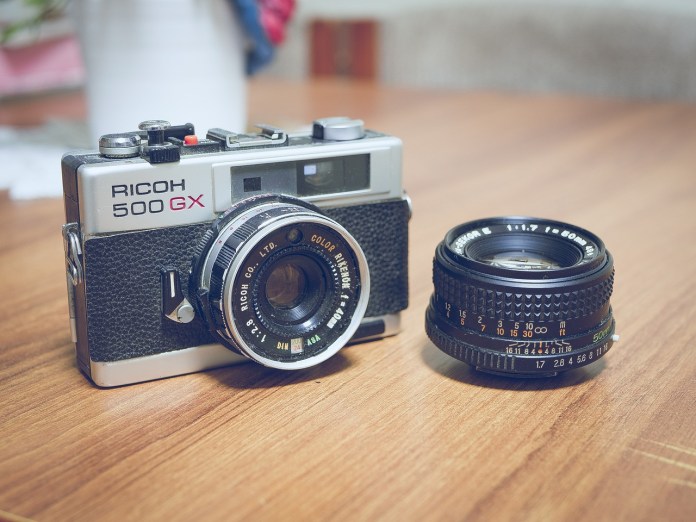
Today as well as my DSLR I have a few compact cameras – my larger zoom one, a slim one that will fit in a bag pocket, and a really pocketable but relatively basic one – and a bridge camera for taking with me in different situations when I know there might be good shots but I don’t want to take the full SLR kit, like when I go out on the mountain bike. I tend to take my old, battered Lumix zoom compact mostly though as it’s a good, dependable all-rounder.

Then there is my smartphone which has a really good camera on it for when I have nothing else with me, though I’ve not really tried anything like the missed Roundhead photo with it.

The phone makers say that the phone cameras can now do anything a DSLR can, that “everyone’s a photographer now” but I’m just familiar with my big camera and know how to quickly get the photo I want from it instinctively using buttons and dials without having to mess around with on-screen controls.

I miss less opportunities now as I can at least get something but there are though still occasional times when I feel that a shot really needs the DSLR and long or fast lens, and those are still frustrating.

Standard