Meta, Tech

The Time Traveller’s Camera

Sunday

Sunday (Photo credit: ex.libris)

This would no doubt be a more interesting title than article really but here goes.  With so many devices around me telling me that this is 2013, and that 2012 is constantly receding into the past how did I still manage to set the date wrong on my new, well-travelled compact camera?

I only discovered this when I needed the timestamp to say March 2nd 2013 to enter a photography challenge and I noticed that the pictures I’d taken were appearing amongst photos I took last year in the date-order view.  The camera had apparently taken pictures in March 2012, before it had been manufactured, while it was still a pile of chips in China.

Yet it was so easy to miss, I’m used to computers and phones auto-updating their date and time now.  But it shows how easy it is to fake the date and time a picture was taken.  The camera can certainly lie these days if not actually time-travel.

Standard
Psychology, Science, Society, Tech

Things Fall Apart…

Warranty Void if Seal Broken

Warranty Void if Seal Broken (Photo credit: eirikso)

Or at least stop working, or didn’t work when you got them, or just won’t cooperate.  But for some reason many people refuse to accept this simple fact of life.

I’ve had three jobs where I’ve had to deal with people who could not accept that what they’d bought had rebelled against them, as they saw it.  If something broke down while in warranty no problem, we’d replace it, fine.  But if it was out of warranty it sometimes became, er, difficult.  You hear “I’ve only had the computer three years, it shouldn’t have stopped working”, “I’ve only had the motorhome three years, it shouldn’t have stopped working”, “I’ve only had the windows eleven years, the seal shouldn’t have stopped working.”  You get the gist.

Yes, some things are designed to last a long time, houses, gravestones, while other things wear out but these days more and more people just won’t accept that and think that it’s unreasonable, the level of annoyance often increases with the amount of money they have. Much of the time people who know nothing about the inner workings of the item will tell you “I know it shouldn’t fail this quickly.”

Many things have a limited lifespan, but much of the time the thing’s worn out because people don’t look after things like locks and engines.  It used to be accepted that some things needed cleaning, oiling or looking after so they’d last for years but, possibly because of our throw-away society combined with so many gadgets which are hermetically sealed up to stop people tampering people are either losing the skills to do it or just feel they shouldn’t have to, even when presented with a big sticker saying “care and maintenance instructions.”   Some people just never read the er, flipping manual.

Then there’s the next difficulty which is when people expect to get a shiny brand-new warranty with the item that’s been replaced under warranty without grasping the idea that doing that could lead to the item being replaced free-of-charge from now until eternity.  “But it’s a new part,” they cry “and you’re telling me it’ll only have a three-month warranty, that’s stupid, I want to talk to your manager!”   Sigh.

I don’t know if it’s the increasing influence of the so-called “blame culture” where accidents don’t just happen, things don’t just break there has to be a reason, has to be someone to blame, someone to carry the cost for you.  There’s probably a hint of the sunk-cost fallacy where you don’t want to let go of something old, or pay more to keep it going because of what you’ve already invested in it.  But really people have to accept that in a universe which tends towards a chaotic equilibrium things decay, wear out, get clogged up with search toolbars and eventually die.

Standard
Society, Tech, Uncategorized

Social Media Awareness – T-H-I-N-K – The Acronym That Stood Out

talin401's avatarTalin Orfali Ghazarian

In recent months I have been writing a lot about this subject about social media, and it is one of the biggest hot topics of this day in age and mostly everything is revolved around social media, promotions, advertising, and so much more that we make social media. Nowadays there are clever ways to advertise and get viewership rolling, making photo acronym’s and there are so many quotes out there that makes people think and social media is one of the biggest ones and all to do with success, business and so much more. Now, what stood out to me the most was this great acronym that says, THINK.

Now, before you Tweet, Facebook, Pin It, Tumblr It, text it, send photos, or do anything with Social Media think of this:

T – is it true?H – is it helpful?
I – is it inspiring?
N – is…

View original post 588 more words

Standard
Tech, Uncategorized

Too Clever?

English: A woman typing on a laptop Français :...

English: A woman typing on a laptop Français : Une femme travaillant sur un ordinateur (Photo credit: Wikipedia)

Some modern software annoys me because it tries to be too clever and as a result it ends up being slow, or a pain to use.  Take the software I use to quickly crop images or convert to mono – in order to get to the image I want to edit it insists on showing me the contents of the folder the image is in, and all the subfolders and the folders around it, all indexed, tagged, thumbnailed and so on.  If there’s a lot of images it can be a while before you can double-click the one you want, especially if it keeps moving around the screen as it arranges the other images it finds into date order like some overly nervous assistant who’s just dropped all your pictures on the floor.  The problem is that I haven’t found a way to change this behaviour yet.

Then there’s autocorrect in many programs which insists on changing two initial capitals into title-case, or inserts a capital where you’ve used lower case because it assumes you’re just a sloppy typist, which I might be, sometimes.  EXcept when I’m typing a POSTCODE.  (WordPress thankfully doesn’t have this yet.)  Oh, and the annoyance when you start typing a chapter and the first line contains the chapter number, after typing a few paragraphs you look up and find that they’ve all been turned into a numbered list.

I know this is all useful for beginners and it can all be turned off somehow but these things were all there in the past but they weren’t automatic, people read the manuals, we created lists on the fly as required, in the very old days we indented lists after typing them and proof-read what we’d we’d written.  Yes.

Often too software is locked down to prevent novice users changing settings that they’re not supposed to even know exists and for those of us who can and like to tinker with the settings that’s annoying too.  What we need is a little switch that says novice/experienced which switches on an old-fashioned, go find it yourself mode, put it behind a “here be dragons” warning like Firefox’s about:config page if necessary but at least give us something to turn off the pseudo-intelligence in one go.

In my own experience it’s more frustrating finding a way around the automatic stuff than finding out how to do these things as you go but as more software is designed for inexperienced users to use without needing to read instructions it can only get worse.

Standard
Nature, Outdoors, Science, Tech

Satellites, Cows and Penguin Poop

English: King Penguin (Aptenodytes patagonicus...

English: King Penguin (Aptenodytes patagonicus patagonicus), West Falkland. Français : Un Manchot royal. Photo prise sur l’île de Falkland occidentale (ou Grande Malouine), dans les Malouines. (Photo credit: Wikipedia)

Many people worry about all the satellites up there pointing cameras down here but for scientists as well as governments they can be invaluable – particularly if you need to p p p pick up a penguin, or 9,000.

In recent years wildlife researchers have used satellite and aerial imagery to watch animal movements and behaviour.  Dr Sabine Begall, from the University of Duisburg-Essen, Germany who had been studying magnetic sensing in animals, initially mole rats, decided to see if larger animals might have the same.  Dr Begall and colleagues used Google Earth to examine how cows stand in fields across the world (to rule out weather effects) and found that the majority faced north or south only, the effect was also seen in deer in the Czech Republic.

In 2009 a group monitoring how penguins were coping with changing environmental conditions wanted to confirm the location of breeding grounds.  Using satellite images, which didn’t have sufficient resolution to see individual birds, they were able to identify colonies due to the staining of the ground by guano – the penguins stay at the colony for around eight months.  The work confirmed the location of 26 colonies and found 10 more.

Then in December last year a team of Belgian and Swiss explorers visited one of these colonies, finding around 9,000 birds.  The article at The Atlantic has the photos.

Standard
Random, Tech, Uncategorized

The Sweet Smell of USB

From the random multi-purpose accessories department.

SAM_0064med

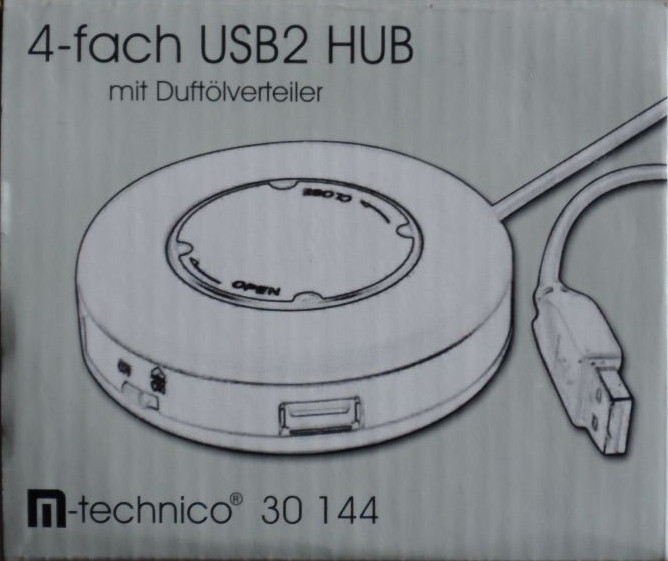
In a shop that sells a variety of items I saw a USB hub for 99p, now as I wanted a powered hub anyway I thought I’d get one.  On the box I noticed it had a disc on top marked with Open and Close.  Was this cable storage, batteries?

The cover was difficult to open but when it eventually gave in beneath it was a cotton pad in a holder screwed into the centre of the hub with no apparent means of removing it.

Stranger and stranger.

SAM_0062medThe box text was all in German, as were the instructions in the box.  So to find out what this strange device’s special feature was I turned to other technology.  I scanned the instruction sheet, used OCR software that came with the scanner to turn it into text for me then copied that into Google Translate.  Less than a second later I had my answer.

“USER GUIDE – USB Hub with Scented Oil Distribution”

I’ve seen USB drinks warmers, fans, reading lights, dancing flowers and Christmas trees but now I’d inadvertently found a USB hub that was also an air freshener.  Sweet.

Standard
Design, Gadgets, Tech

Personalised News

English: A simplified version of the RSS feed ...

English: A simplified version of the RSS feed icon.  (Photo credit: Wikipedia)

Sometime in the late nineties I wrote a sci-fi story and in one scene a man gets home, taps a touchscreen on the wall of his kitchen and instantly brings up a personalised news feed programmed to display things that interested him and also set up to specifically look for news items featuring certain keywords, to highlight any news about a specific ship in this case.

Now just a bit over a decade later I’m just getting to grips with this exact same thing on my own personal tablet computer, though without the spaceship captaining wife.

Websites, including these WordPress blogs, can provide what is called an RSS feed which summarises each article published and these can be picked up by reader apps.  These have been around a long time admittedly but these readers are now becoming more sophisticated and stylish.  On my Nexus 7 I have tried Google Reader, Flow Reader, Google Currents, Flipboard and Feedly.  Some apps actually access your Google Reader subscription list to find out which feeds you want to receive.  You can even view other RSS equipped sites in your WordPress reader.   The icon above signifies that a site has an RSS feed.

These apps are the solution to the at time overwhelming volume of information that can come at you from the internet.  This sheer volume of articles is one of the reasons why I sit down to write something for this blog and just decide to have a mug of tea and watch tv instead, I just don’t know where to start.  With an RSS reader on a phone or tablet I can skim through articles, share useful ones to Pocket for use later on my desktop PC and read anything that I can just enjoy in the moment – all while half-listening to the tv.

The nice thing about these modern readers is the way they present the content.  You can filter what you see so if you have a news website’s feed you could refuse to acknowledge the existence of articles about X-Factor winners or only view articles about the weather or Wills and Kate.  Then depending on which app you choose you can have a list of your incoming torrent of news, divided into subject if you so wish or displayed to you as a virtual, stylish, one of a kind digital magazine, or a mixture of both.  Of course as it’s tablet/smartphone based (although you can use PC RSS readers or websites too) you can have notifications.

The future of news, personalised and delivered to your sofa.

Standard
Photography, Psychology, Society, Tech

The Fears of Street Photography

Asian Woman photographing with her digital cam...

Asian Woman photographing with her digital camera in the historic streets of Prague. (Photo credit: Wikipedia)

A good photo will often tell a story, convey a message, and to do that you need some kind of context whether it’s the weather, movement, light or people.  Street photographers are very good at images of the latter as by definition they are the subject and the context.  For many photographers, myself very much included people are a difficult subject because of a modern fear.

I stopped going out with my old film cameras around 1998 because I was getting more and more suspicious and almost angry looks from passers-by even when I had the Ricoh SLR on a tripod in an otherwise empty park shooting a landscape, there just seemed to be an atmosphere of people thinking there was something strange about photographers – this was shortly after the furore about the paparazzi in the late 90s.  Maybe it was just me but I felt uncomfortable being seen with my camera.

Having started again I still feel the same.  In my camera kit holdall I have a card that outlines the current law in this country which was given away with a magazine last year because of the number of photographers who were being, sometimes angrily, confronted by members of the public telling them that they were actually breaking the law by photographing people or even buildings – in fact if you’re in a public place you can photograph most things and people, including the police or armed forces, as long as you’re not photographing someone inside a private building where they would have an expectation of privacy.  There are today many people who do fear the motives of people with cameras.

I bought my new high-res and well-travelled compact camera last month so I could carry that with me in case I saw a picture and didn’t have my DSLR.  Yesterday I saw a lovely view down a shopping street where I live, the late afternoon sun lighting buildings in the distance, ominous grey clouds on the horizon by contrast, people doing their shopping.  I didn’t take my shiny new camera out of my pocket, I chickened out, all because I was afraid that some of those shoppers would think I was some kind of weirdo and confront me about it.  Ten minutes later I saw a group of tourists taking photos round the corner and nobody seemed to be making anything of them.

The subjects of many street photos probably didn’t even notice they were being photographed, while photographers will often even ask permission to take shots, especially close-up, non-candid shots.

The thing is that I know I’m not alone in feeling uneasy, of being afraid of the public’s potential reactions to photographers, even though I’m sure that most people wouldn’t even think twice about a chap with a camera.

Standard
Business, Science, Tech, Transport

The New Age of Sail

"Tres Hombres"

“Tres Hombres” (Photo credit: Nolleos)

If you had visited Copenhagen recently you could have seen a 32-metre long twin-masted sailing ship, a brigantine, called the Tres Hombres arriving at the dock but this wasn’t some romantic recreation of a bygone age the ship carries up to 35 tonnes of cargo, and has been doing since 2009.

As reported by the BBC this week the business is one of many new projects underway to again use sail power to transport goods.  Most freight carriers only travel at about 15 knots today, to save fuel and reduce emissions whereas ships such as the Tres Hombres travels at 10 knots which is not really much slower.  Many companies who are concerned about their energy usage and the effects of their logistics on the environment welcome the low impact nature of sail – current cargo shipping equates to being the sixth largest emitter of greenhouse gasses on the planet.

The only problem however is the unpredictability of the wind but even this can be solved today by the use of engines when the wind isn’t cooperating.  One company, B9, is designing a large cargo ship which combines carbon-fibre high-efficiency sails with an engine that runs on bio-gas from food waste.  Modern technology even allows for the weather to be predicted so as to make the best use of the wind and engine throughout a voyage.  Models have already been tested at Southampton University and the results used to optimise routes.

Lastly Skysails, a German company, is looking at marketing systems of giant kites to provide assistance to large conventional cargo ships and in Japan the University of Tokyo is also looking at sails on cargo ships.

It is still a niche idea at the moment but as the BBCs report shows as fuel costs increase and world trade continues to increase the modernised technology may once more have its day.

[BBC News]

Standard
Music, Psychology, Random, Tech, Work

Hold On, And On, And On

Típica cabina roja de Londres - Red telephone ...

Típica cabina roja de Londres – Red telephone box – London (Photo credit: Arabarra)

In my work I’m regularly put on hold as suppliers find out whether they’ve got something, when I can have something or why I haven’t received something.  Most of the time the hold music is cheesy, generic and bland but mostly irritating which I suspect is to encourage you to hang up and go get a coffee instead.  Some companies have even started replacing the music with constant ads for their products, one of my suppliers never really changes the product range and I’ve found myself saying, without thinking, “I know about that, we buy it already”.

Which reminds me; always bear in mind that when you’re on hold the person on the other end can often hear you even if you can’t hear them so don’t be impolite unless you want them to know you’re pissed off.

New research by TalkTo and ResearchNow has found that people spend on average 10-20 minutes per week on hold, which equates to 43 hours in a lifetime.

Only twice in twelve years have I been impressed by being on hold.  Once was with a company which used “I Need a Little Time” by The Beautiful South.  The other was a firm who always had a good variety of good, modern, well-known songs to listen to while you waited, you felt slightly disappointed when it ended.  There was one song they played I hadn’t heard since I was clubbing years before and, I’m not embarrassed to say, I did dance to it behind my counter.  Which is one way to spend those 43 hours of your life you’ll never get back.

Standard