Psychology, Society, Uncategorized, Work

All Wrapped Up

Shrink wrapped helicopters

Shrink wrapped helicopters (Photo credit: Wikipedia)

Ikea have a lot to answer for.  Well, not just Ikea really but retail outlets in general, combined with the general idea of everything being available to conveniently take away.

A while back a customer arrived to collect a mirror, this is a custom mirror, hand-cut, semi-hand-polished, we don’t have off-the-shelf mirrors, or double-glazed units, or windows, the world just isn’t that standardised, as I’ve discussed before.  Anyway, I brought the mirror out and carefully placed it down, sitting on its corner protectors which stop the polished edge being chipped.  “Is that it?”  he boomed.  “That’s the mirror you ordered.”  “But aren’t you going to wrap it up in something, it’s gotta go in my van, what the f**k am I going to do with that?”  I use a question mark there but it may have been a rhetorical question.  I said that we didn’t have any cardboard or bubble wrap.  “Right, I’ll go and sort my van out and wrap it up my f*ing self then.”

Someone else ordering a double-glazing unit recently asked “will it come packaged up?”

This is the thing, if you buy a timber door from a DIY store it’ll probably have a bit of shrink-wrap around it it protects it from rubs but not knocks as such, we don’t have the facilities to package everything and it’s impractical to keep packing materials in all the time, if we do have some card and people ask then we will wrap things up, the problem is the expectation of it being packaged and the reactions if we can’t.

Most of our products are supplied to trade people who turn up prepared, with vehicles suited to the task but more often people turn up in vehicles that are too small for the glass or come without anything to support it at all.  At the opposite end of the scale one customer used to turn up with a specially made tray on the roof of his car for carrying mirrors and another had built a timber support inside his car to move one glass unit – which was an impressive level of preparedness.  Most customers at the moment do come prepared in one way or another, even if it means five minutes of me standing by the car holding the glass while they remove jacks, toolboxes, shopping and so on from the car boot before spreading out an emergency tartan blanket as support.

For the rest though the explanation is the takeaway society – people expecting to not have to do anything themselves, just turn up, have it wheeled out and put in their unprepared car.  Their food comes in packages in the supermarket, their furniture comes in boxes, or delivered in vans, so it comes as a shock to find something that doesn’t conform to their expectations it’s just unfortunate that so many people’s reaction today is not to either ask politely if we might have something to put round the glass, or say that they’d go and get something themselves or a more suitable vehicle but instead to refuse to acknowledge that they may have overlooked the transport issue, to blame the supplier, to lash out with indignation and exclaim angrily that it should be wrapped up, that it’s our duty, that it’s the law – nothing comes unwrapped these days, don’t we know that, it’s a basic human right for goodness sake.

Ahem, sorry.  Anyway, it’s late here so I will just wrap this up for you now.

Standard
Psychology, Society, Tech

Hanging On

iPhone Original/3G/4/5

iPhone Original/3G/4/5 (Photo credit: Yutaka Tsutano)

As I write this many, many, many Apple devotees will be glued to their laptop screens, sorry, MacBook screens or iPads relishing the latest “one more thing” revealed by Tim Cook*.  I’ve not gone out of my way to have a look at the new iPhone(s) or whatever, I’m neither an Apple fan or an Apple hater though I’m not a fan of some of their actions surrounding patents though that’s something for another time.

What I’m thinking about is the trend of getting a new gadget every year.

Moore’s Law is an observation that the number of transistors on an integrated circuit tends to double every two years or so, this is usually misquoted as computing power doubles every eighteen-months.  There was a period recently when phone manufacturers seemed to be releasing new phones every month, though in truth they often catered for different markets and budgets, now though every major phone or tablet is refreshed every year, it’s like Christmas – literally, for the manufacturers, in June, August, September.

Computers are less obvious because there is still a steady stream of new models with slightly different cases, tweaked internals, new chipsets.  The common factor is that often the jump in actual power between last year and this isn’t that great, and usually the main difference in phones has been screen size and resolution.

Still though some people feel the need to buy again and often the reason they give is that the new one is so much faster than the old one.  Sometimes I’m sure this is true – as new software and features make an old phone, tablet or pc seem slow, if you’re trying to watch an HD video on an older phone for example but sometimes it can simply be that over time the device starts to feel slow.  When you first got it it was blindingly fast, menus appeared instantaneously and web pages were super-quick to load.  Now though you’re waiting forever.  What’s changed?

Ok, sometimes new software has features that cause an old laptop to chug, some websites (Flickr is a personal annoyance) have redesigned in such a way that you need quite nifty hardware to get a smooth experience, and of course you might only be able to watch a video in SD.  Much of the time though nothing has changed except your perception, you get used to the menu appearing, your memory of the previous computer fades into the mists of time and you don’t have anything to compare your current computer to but…

…the shiny new one at work, or in PC World.  The difference is miniscule, the slow website might still be slow on your new PC but confirmation bias will tell you it’s still faster.

My laptop is from 2008 and with the exception of a couple of websites (do I need to mention Flickr again) it’s still fast enough for everything I do, even my new copy of Photoshop Elements.  My Nexus 7 is less than a year old and has been superseded by a new N7 with an even higher resolution screen – I won’t be “upgrading” because I don’t really need to watch films in even more sparkly high-res on a small screen than before.  My phone is similarly a year old and still feels nippy and crisp, it still does everything I need it to do and I don’t feel the shame of having “last year’s phone” that drives many people to upgrade.  I know that one day my laptop will either completely die or the web will get too much for it to cope with, then I’ll upgrade,  Sometimes it seems that the only upgrade people need is to their need to define themselves by their possessions or their patience, though it does seem that that’s something lacking everywhere these days.

Perhaps I’m in the minority, there will no doubt be lengthy queues outside Apple stores soon.

* – yes, I know “One More Thing” was Steve’s thing, not Tim’s.

Standard
Tech

Don’t Take My Buttons Away

English: The Nikon D7000 is a 16.2 megapixel d...

English: The Nikon D7000 is a 16.2 megapixel digital single-lens reflex camera. (Photo credit: Wikipedia)

I’m not alluding to the fact that my trousers would fall down or even that I’m addicted to little discs of chocolate, I’m becoming concerned at the proliferation of touchscreens and the like.

In computers, smartphones, cars and cameras it seems that push buttons and switches are seen as old-fashioned, not versatile enough, not eager to change colour or function at the drop of a hat, they’re so last century but wait a second, they still have value.

Some devices like a digital SLR camera have functions that you need to change quickly attached to a button, you instinctively reach for it with a finger tip, press it, twiddle the input dial and viola you’ve dialed in some exposure compensation.  The process of just knowing where the control is is called muscle memory and it’s very useful, so much so we often don’t realise we’re using it.  I’m using it now, I’m typing this without looking at the keyboard.  Now it’s true that’s possible with a touchscreen but only if you have a physical reference to start from and the display doesn’t change – with an actual button you only need to know it’s near your index finger, you just fish around for a second and know what the right one feels like, on a screen there’s, at the moment, no tactile cues.

The other problem with touchscreens is also that they tend to group all the controls on the back or front of the device so for example on the Samsung Galaxy NX camera, and other touchy-feely controlled cameras you have to take your eye from the viewfinder in order to fit your fingers between the screen and your nose.

So speed and practicality are on the single-minded, independent buttons’ side but what about safety?

Huh? you ask.  I’ve mentioned before how the same principle reduces the amount of time you’re looking away from the road when driving a car with physical controls rather than touchscreens or joystick-driven menus.  Until voice control gets to the KITT-level conversation style I’m not happy giving up my in-car knobs and dials.

As for voice control of phones and cameras, it’s fine until you find yourself trying to adjust a setting on your camera while not wanting to look away from the viewfinder but also being aware that asking your camera nicely if it wouldn’t mind changing the aperture to f/8 might be inappropriate to the setting.

Fashion seems to be pushing tech companies and car makers towards more minimalist devices, their faces just a screen of morphing, interactive controls, often for the sake of it, but good design shouldn’t compromise usability and sometimes the most usable control is the humble physical button.

Standard
Business, Marketing, Random, Tech

Everything’s Better With Bacon

Horse And Cart

Horse And Cart (Photo credit: foilman)

To be honest I quite like the adverts for the UK’s EE phone network featuring the always-connected Kevin Bacon, even if I’m not a fan of the name “EE” – at least I can still say I’m on Orange if anyone asks.  The latest ad dips into popular colloquialisms for its inspiration and shows Kev dragging a “shedload of data”.

My first thought was where they could go next with the idea:

“Why you lugging a cart of manure Kev?”

“That’s not manure, it’s data, it’s a metric shit-tonne of data.”

There you go EE, have this one on me.

Standard
Business, Film, Tech

A Digital Future for Film

Canon EOS C300

Canon EOS C300 (Photo credit: kenjonbro)

When I was younger it seemed like an eternity between a film being on at the pictures and it being on telly.  Which was because it typically was an eternity.  By the time a video of it came out it was almost forgotten which was perhaps the idea, to be absolutely sure that every last drop of cinema cash had been wrung out of the celluloid and it was ready for people to relive in their own homes and pay for over again.

Today though the Amazon pre-orders for the blu-ray of a summer blockbuster are up before the first pair of 3D glasses are slipped on at the local multiplex.  Still though it would surely be madness to release a film in cinemas if it were, for example, shown on Film4 at the same time?

Maybe not.  A Field in England, a film by Ben Wheatley was released on 5th July across formats – on disc, on-demand, on TV and on the big screen.  The black-and-white film, shot on Red Epic and Canon C300 cameras tells the story of three deserters from the English Civil War who are forced to help an alchemist search for mushrooms in the aforementioned field – which is its sole location.

It is both the production and distribution that are important though.  The digital technology to film and distribute the movie are likely to reinvigorate the industry as lower-budget films become increasingly viable.  The widespread outlets enabled Wheatley to reach the greatest audience possible and he believes that it wouldn’t reduce the cinema audience for example – there will always be people who prefer to see a flick on the big screen and others who will always wait for the DVD or TV so why not give everybody what they want from the start.  The film received funding from the BFI which supports experimental release models and the distribution was in collaboration with Film4 and Picturehouse Entertainment.

So it seems that despite the fears of some in the entertainment business 21st century filming and distribution technology looks like creating a renaissance in film rather than signing its death warrant.

Standard
Health, Science, Tech

Cast of Thousands

English: Fig 57 on Page 190. A broken arm in a...

English: Fig 57 on Page 190. A broken arm in a splint Flickr data on 2011-08-17: Tags: public domain, copyright free, illustration, drawing, image, Points in Nursing, 1910, Emily A. M. Stoney License: CC BY 2.0 User: perpetualplum Sue Clark (Photo credit: Wikipedia)

People are always saying “oh, you’ve just got to do this before you die” about so many things; seeing the sun set over the Kalahari, visiting Thailand, touring Italy, bungee jumping, and so on.  Breaking your limbs, however, not so much of a must-do and, call me insane if you must, personally I’ve avoided the experience as much as possible.  So far I’ve only managed to crack a clavicle.

One thing I would dread is the cast – the ugly lump of white plaster, er, plastered around your limb getting progressively grubbier and inevitably itchier with every passing day, getting in the way of normal clothes, making it awkward to sleep, bathe, eat and so on.

Well a solution may be on the horizon – Jake Evill, a Victoria University of Wellington graduate, has designed a concept for a modern replacement utilising the current wonder-tech of 3D printing.  While home 3D printers let us make little plastic models this concept spits out something very neat – a lattice-work structured, washable, hence hygienic and non-itchy, cast created using x-rays of the limb fracture which can concentrate its strength and rigidity where it’s needed most around the break.  It would be assembled and fitted together with permanent fasteners to prevent it being taken off prematurely or accidentally and would then later be sawn off in the same was as a conventional cast.  Another advantage is the plastic could potentially be recycled.

Once the current print time of 3 hours reduces this could be the more comfortable and less obtrusive future of broken limbs – just, as Gizmodo’s article points out, without the friends’ decorations.

[Gizmodo / Dezeen]

Standard
Tech

Cloudless

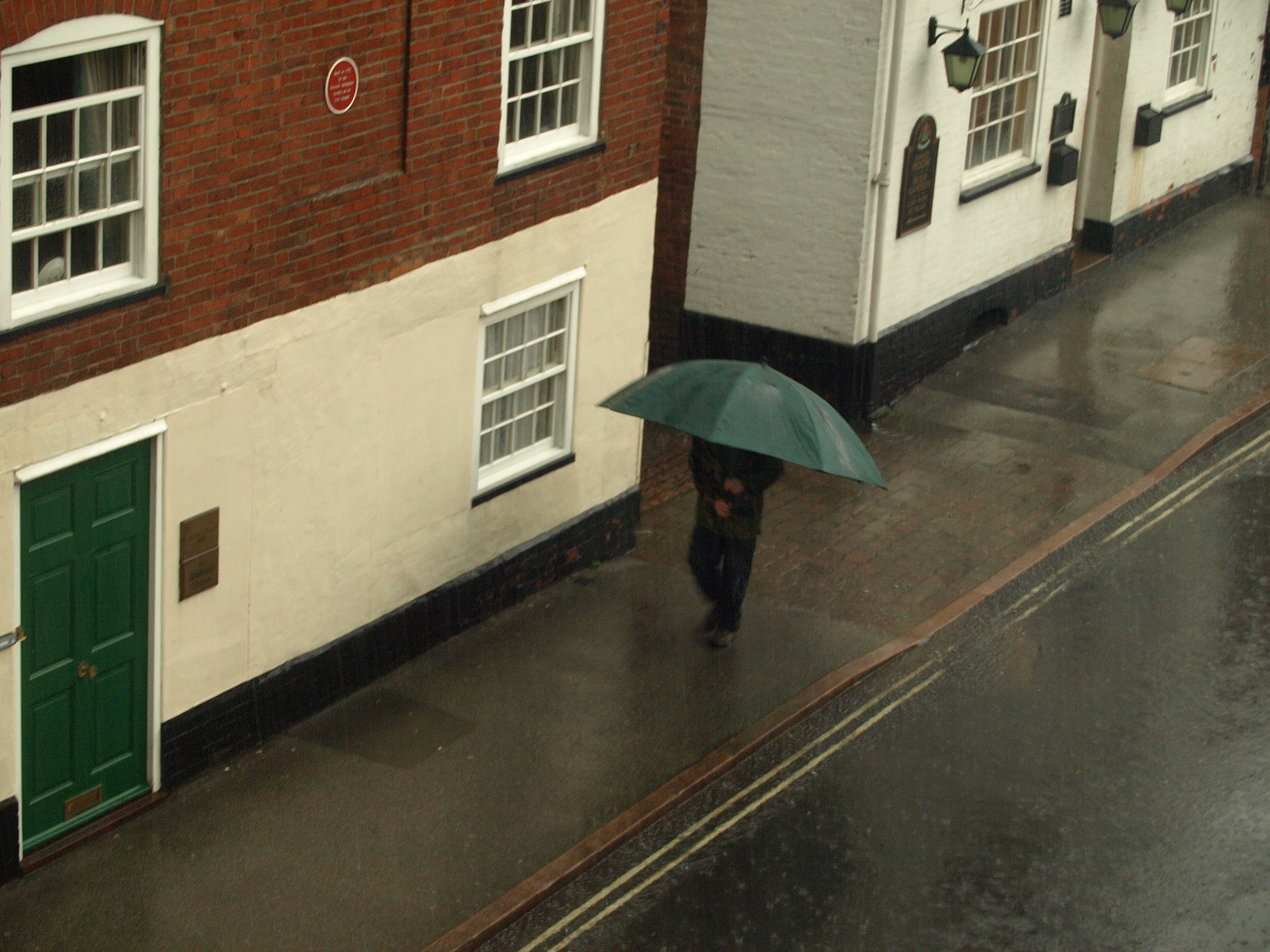
Heavy Rain

Heavy Rain (c) 2013 Andy Vickers

Like walking into a house when you’ve been away for a while I pull off the dust-sheets and open all the curtains…

It feels like such a long time since I’ve been able to post anything here, in reality it’s been a couple of weeks that I’ve not been able to access The Lunch’s dashboard or create new posts.  At first I thought it was my browser, my computer, my ISP, I searched online for WordPress issues but couldn’t find anything so was stumped.  Then finally via Google I found mention of a similar issue on another blog which told me it was a problem with WordPress servers being blocked by ISPs due to someone’s blog breaking Terms of Service.  A demonstration of how one persons actions can cascade on systems like the internet.

Secondly the other week we had rain that looked like a monsoon, almost as dense as fog, waves of water were flowing off the tops of roofs across the road, the road outside itself became a river, water erupted from drain covers.  One driver of an expensive saloon car *cough*a BMW*cough* clearly felt that a couple of inches of water was too risky and reversed back then drove down the pavement instead while others ploughed through regardless spraying people and buildings with torrents of water.  One especially impressive young man managed to leap completely over the large bow-wave created by one passing car as it rolled along the pavement.  As usual I watched the rain and lightning, listened to the thunder.

All seemed ok that evening as the storm passed and things settled back to normal.  The next evening though I found my landline phone wasn’t working, seems the storm had taken out the phone lines locally, and then the terrible reality struck.  NO INTERNET EITHER – The Cloud taken out by Rain Clouds.   Arghhh.  I couldn’t even use 3G on my mobile because I hadn’t got enough credit.  It didn’t bother me that much, the emails can wait, I’d perhaps miss one of the Deals of the Day emails but there probably wouldn’t be anything decent anyway.  I watched some TV then thought about listening to some music, the new CD I’d ordered for example, I’d got the MP3 version free, downloaded it and then uploaded it to Google Music, I’ll listen to that…  Ah.  Maybe not.

Luckily I’d still got it on my computer too (the CD itself hadn’t arrived yet) so I could still listen but it was a little reminder that when you put everything in the cloud and you lose your connection you’re stuffed.  This is why I only use cloud services as backups or as a quick and convenient way of accessing music or photos on just about any device I have.   Other services like Evernote and Wunderlist will sync with the cloud database once reconnected so at least they’re still usable locally.

Lifehacker has some useful advice in case of internet outages including using a mobile hotspot or tethered 3G phone, borrowing a neighbour’s internet or using public wifi if these are available which shows that thinking ahead can save the day but even then at the wrong time you might still be netless.

Maybe one day the dreams of the likes of Google with their (mostly) everything-online Chrome OS will be realised but we’d need an internet that only goes off when the power to run the computer does too.

Standard
Cars, Science, Tech, Transport, Uncategorized

Running on Sunshine

Solúcar PS10 es una planta solar termoeléctric...

Solúcar PS10 es una planta solar termoeléctrica por tecnología de torre, la primera en el mundo explotada comercialmente. Solucar PS10 is the first solar thermal power plant based on tower in the world that generate electricity in a commercial way. (Photo credit: Wikipedia)

I am interested in cars, nice cars.  I’d particularly like a new Jaguar F-Type, an orange one, if anyone’s feeling generous.  I’m telling you this in case you think this post is in some way biased.

I’ve just read yet another article about another designer with “eco” credentials planning a zero-emission or in this case emission-free car.  This one was a hydrogen powered car but others have been fully electric.  I have a little issue with the idea that these cars have zero-emissions.  It’s a case of semantics.  Petrol, diesel and hybrid cars have a pipe at the back that makes you cough like you have a forty-a-day habit if you wrap your lips around it, electric and hydrogen cars don’t, hydrogen cars even put water back into the environment, combining the hydrogen with oxygen in the power production process.

All good yes?  Well, apart from indirect emissions.  Electric cars are charged from the mains which at the moment requires mostly fossil-fuel powered generation.  Hydrogen, although common in the universe has to be extracted here on Earth and that takes…  electricity, fossil-fuel, etc.

I’m discounting the environmental impacts of building the cars in the first place as even the advocates of these technologies don’t deny that.

The thing is that cars won’t be truly zero-emission until we can generate power widely without emissions.  Some nations are fortunate to have abundant geothermal or hydroelectric power resources but for the rest of us we need to look elsewhere.  Nuclear power is still controversial, though the technology is still being refined to be safer in the long-term and new thorium reactors can even use previously created waste plutonium.  Personally, for cars at least, I think hydrogen is the way forward and another emerging technology is the way to make it.  In hotter countries such as Spain large solar power stations (see above) have been built that focus the sun’s immense power onto arrays of receivers which can be used to heat water to drive generators and generate electricity.  If you use that electricity to power a plant that creates hydrogen then the power created from the Sun’s energy is portable beyond the locality of the power station.

To places like this where we’re enjoying our couple of weeks of sunshine.

Standard
Uncategorized

The Nature of The Town That I Live In

English: Sinks in the public toilet of the Cas...

English: Sinks in the public toilet of the Castle Terrace Parking Garage in Edinburgh, Scotland (Photo credit: Wikipedia)

The other evening I looked out of my window and saw a lad stood on the pavement below, apparently waiting for someone.  Seconds later another appeared from the archway inside which are the entrances to our apartments, he was clearly buttoning up his trousers having used our front doors as a public toilet.

It’s increasingly common today for this to happen – on homes, shop doorways, alleyways – and I’ve often wondered how they’d feel if I was to, for example, follow them home and piss on their doorstep.  “What the f*@k you doing?” he’d shout, “that’s my front door.”  To which I could reply “well you pissed on mine, I thought I’d return the favour.”  I wouldn’t because the sort of inconsiderate moron who thinks it’s ok to piss on someone else’s front door would react as only an inconsiderate moron would; not understand the point and lash out violently.  It’s not worth the hassle.  The thing is that often you’ll see people come out of the pub opposite, walk fifteen metres towards the town then piss on the wall or doorway of the workshop across the road from our building – as my folks would say “you should have gone before you came out.”

A few weeks ago as I was driving to work (which I rarely do) I got to the end of our street and as there was traffic approaching I stopped, I glanced in my mirror to see an idiot screech to a halt behind me.  He then started waving his arms at me, gesturing that I shouldn’t have stopped, to move, I could see him shouting “GO ON, F**CKING MOVE” – no doubt trying to impress his girlfriend with how he could order other drivers around.  I gestured at the car that was at that point passing in front of me and that would have been, if I hadn’t stopped, impaled in my driver’s door.  Later the same day another driver pulled out in front of me and I had to slam my brakes on, that driver started mouthing off at me because he’d stopped too, as though it was my fault for being there.  Finally, the next day I got shouted at while walking because I’d had the audacity to use a pedestrian crossing and made the driver stop.

This afternoon I went out onto the balcony to read for a while in the sunshine and saw two men from one of the houses along the street dropping numerous bags of cans and beer bottles into the large bins that are for the use of the eleven apartments of our building, they are usually overflowing by collection day so the last thing we need is other peoples’ rubbish too.  They disappeared back into their own garden before I could say anything but a neighbour from our building was driving out of the car park as they came back to put more rubbish in our bins – walking past their own in the process.  He asked them nicely not to use ours and they walked towards their own, inevitably though as soon as he’d gone they turned round and put the rubbish in our bin, muttering something about my neighbour and saying “it’s not like they’re not big enough.”  I said that they fill up quickly but they ignored me too.

Three stories of the attitude of so many people today, they’ll do what they like regardless of what anyone asks, other people’s feelings or whether they’re in the wrong.  In the end they just have no respect for anyone at all.

(The title is from a song by Indigo Moss)

Standard