Business, Jubilee Britain, Tech

Keep Calm and Carry British Tech

Contemporary rendering of a poster from the Un...

Contemporary rendering of a poster from the United Kingdom reading “Keep Calm and Carry On”, created during World War II. (Photo credit: Wikipedia)

Look at your phone or tablet, most will say Made in China, Korea or Taiwan, some will say Designed in California, but what about the technology at the very heart of the device?  Where were the creators of that based?  Silicone Valley?  Shenzhen?

More than likely they were based in the UK.

Despite the likes of Jeremy Clarkson implying that if it’s designed or made in Britain then it’ll inevitably go wrong our nation has produced some of the best minds in technology, architecture, literature and science…  in the world.

Most PCs, even Apple Macs run on chips that are designed to be compatible with the Intel processors that powered the earliest IBM PC and their dependents.  Mobiles though need less power-hungry processors and this is where the Brits come in.

Back in the eighties Acorn (who had created the BBC Micro computer to accompany a pioneering TV show intended to teach computing to the public, and one of the first computers I learnt on) created the Acorn Archimedes which used a RISC processor – which basically uses a simplified set of instructions to run programs which allows for powerful processors using less actual power – perfect for mobile devices which was why Apple chose the processor for their Newton handheld and were one of the three partners that formed ARM.  Our school had an Archimedes and it seemed like a glimpse of the future compared to the BBCs and PCs.  We had no idea.

Since then ARM has developed the core designs that they licence to manufacturers such as Samsung who build the chips that drive iPhones, Galaxy SIIIs, HTC One Xs, LG Nexus 4s, Nexus 7s, Kindle Fires…  You get the idea.

The other company that has done the same with graphics chips is Imagination Technologies.  In the early nineties Hossein Yassaie joined the company and decided that computer graphics were the future, shortly afterwards he decided that people would one day want to do everything they could do on a PC on a mobile – a vision that seemed impossible to many at the time due to limits of the available technology.  However, like ARM, Imagination’s technology had lower power demands.  As smartphones have taken off, so has demand for both ARM and Imagination’s designs.

Their strength lies in the demand for new phones, the latest, faster, brighter, better, smarter every year; chipmakers couldn’t each dedicate the kind of design teams that the British firms have to such projects and so licensing from these independents is the perfect solution, and of course having so much design talent and experience in just two companies helps to ensure constant innovation to keep us all equipped for the future.

[Also BBC News]

Standard
Politics, Science, Tech

Online Democracy: Death Star Edition

Death Star Memorial

Death Star Memorial (Photo credit: sabertail)

Both the UK and USA have websites where the populace can start e-petitions to highlight concerns on subjects as diverse as immigration, the health service, troops in Afghanistan and whether the US should build a Death Star by 2016.  Er, pardon?

To quote from the petition:  “By focusing our defense resources into a space-superiority platform and weapon system such as a Death Star, the government can spur job creation in the fields of construction, engineering, space exploration, and more, and strengthen our national defense,”

Admittedly noble sentiments but a Death Star, really?  Seems some people just can’t let go of the Star Wars programme.

I’m reminded at this point of the end of Dr Strangelove…

[Washington Post]

Standard
Business, Society, Tech

The Internet Isn’t Free (of Charge)

Credit Card

Credit Card (Photo credit: 401(K) 2012)

We take it for granted today, we sit down, fire up a browser on our computer, tablet or phone, load up our favourite news site, tech blog, webcomic or whatever and for most of these we don’t have to have ever entered any credit card details – unlike buying a magazine or newspaper.

And then many people complain about adverts and install ad blockers without considering one important thing; without the ads the website wouldn’t be there, or you’d have to pay for it yourself.  The other problem with this expectation of no-cost browsing is that sites like Wikipedia which don’t have ads still have to pay for servers, offices and the staff who look after the site despite having an army of volunteers but don’t receive enough donations to keep going.

This blog is provided ostensibly free of charge via WordPress but has adverts (visible to non WordPress.com users) which I have never seen myself but have been reliably informed are there, I couldn’t justify paying for the ad-free version at the moment.  I personally only block adverts on other sites I visit that cause problems with my browser as I appreciate that ads are a necessary part of our free and open internet, just as regular users of donation-based sites aught to donate.

Someone once said there’s no such thing as a free lunch, and for the moment this one’s no exception.

[How Much Would You Pay For a Wikipedia Subscription]

Standard
Architecture, Tech

Welcome Home

bath & candles

bath & candles (Photo credit: elprofeabra)

Imagine a home that senses how you’re feeling when you arrive home, if you’re apparently feeling worn out it automatically alters the lighting, sets the perfect temperature and runs you a bath. Or one that detects lots of people, music etc and knows it’s a party and turns the heating down a bit for everyone’s comfort.  This could be part of the future of architecture – buildings that can feel, that can sense their environment and their occupants and react accordingly and a building in Paris has been equipped with sensors and interactive elements that allow the building to learn about its visitors and react to them, even to the point of choosing who to allow into its very heart.

One day, with the advances in sensors which could be built into appliances and fittings could even detect health issues.  At the basic level your home or office could just put itself to sleep to save energy when you go out.  Just don’t forget to say goodbye and goodnight when you go on holiday.

Watch the BBC’s video report here

Standard
Business, Marketing, Tech

Who’s Watching?

"Pay attention to me!"

As well as my online home here at WordPress I also regularly add pithy, witty, insightful comments on Gizmodo UK.  Well, when I have time and can think of something witty and insightful before someone else beats me to it.  I remember well the day when I got the email that told me I’d earned enough love and respect of my fellow commenters to get a gold star and the awesome responsibility to reward others and uphold the standards of good commenting that comes with it.

The comments sections of many blogs like Giz UK have a warm community feel to them, many are more, ahem, hostile but generally people are open and honest with their opinions.  The thing is though that you never know who else is reading the comments.

Imagine you’re in the pub with your friends discussing last nights match/Eastenders/curry/pint/copy of GQ when a man in a suit with a clipboard sits next to you and starts making notes, then politely corrects you on a couple of issues he has with your opinions.

Well, this is what some companies are already doing – dedicated staff trawl the internet for any mention of their products in comments and articles, ready to possibly intervene if a discussion starts to become negative.

It’s all part of the market research of course but it can, sometimes, make you wonder who’s looking over your virtual shoulder.

[Gizmodo UK]

Standard
Psychology, Society, Tech

Radio Daze

Cat sitting on a radio, Sydney, 1930s / Sam Hood

Cat sitting on a radio, Sydney, 1930s / Sam Hood (Photo credit: State Library of New South Wales collection)

I’m listening to the radio and the presenter, earlier in the show, said that the weather was going to be mixed, with some rain and possibly some sunshine later.  Since then he’s been bombarded with tweets along the lines of “it’s raining in Lincoln, isn’t that where they’re meant to be based”, “dunno what window he’s looking out of, it’s raining here” and similar.  Is that what these people are thinking “it’s raining now, it’ll rain forevar….”

He has resorted to saying “I know it’s not sunny NOW, it’s called a FORECAST.  If you want to know what it’s like now you can just look out the window.”

Standard
Gadgets, Music, Tech

HBCD

Compact Disk

This could make me feel old but I’m not going to let it.  This year the CD celebrates its thirtieth birthday.  I was seven when I watched the famous demonstration on Tomorrow’s World of how you could spread jam on it (clean it off) and it would still play.  They didn’t mention that it you cleaned it with anything more scratchy than a swan’s tail feather and then played it in a less than perfect CD player it would skip more than, oh I don’t know, a bush kangaroo.  But in those early days Sony and Philips’ shiny new disc and player were the future of high quality, high fidelity digital music in a time where computers still had mono screens and games consoles still had faux-mahogany cases.

Today MP3 downloads and streaming services like Spotify are said to sound the death knell for CDs, like those same hypnotic discs were meant to do for vinyl.  I still buy most of my music on CD because I like the experience of getting a new album, opening the case, putting it in the CD player and listening to it all the way through while looking at the booklet.  Once it’s on the computer it’s all to easy to skip tracks and shuffle it with all the other albums.  But then I’m the same with books.  Sales may fall but I’m sure there will be plenty of people like me willing to buy them for some time still.

So happy thirtieth you little iridescent disc you, many happy returns, or should that be repeats.

Standard
Tech

I Heard It On The Wireless

While there are still hundreds of CD players available more and more people have digital music, even if, like me, they buy a CD then rip the tracks onto a computer.  Having all, or a large portion of your music collection in your hand isn’t a new idea but recent advances have made accessing it so much more than just plugging in headphones.

No more sitting intimately close to your CD player, having to remember not to move too far for fear of yanking your equipment off the shelf or your ears off your head; no more long extension leads trailing across your living room ready to trip up your unsuspecting nearest and dearest.  No, now technologies like Airplay, DLNA and Bluetooth enable quick and simple wireless connections between phones, PCs and speakers and Near Field Communication technology lets phones like recent Sony and Samsung models connect to an output device or share a playlist with a simple tap.

Add into this phone and tablet apps that can remotely stream from or control a computer, or a dedicated media streamer and you can access your whole library of digital music and films at the touch of a screen, through your hi-fi or TV.

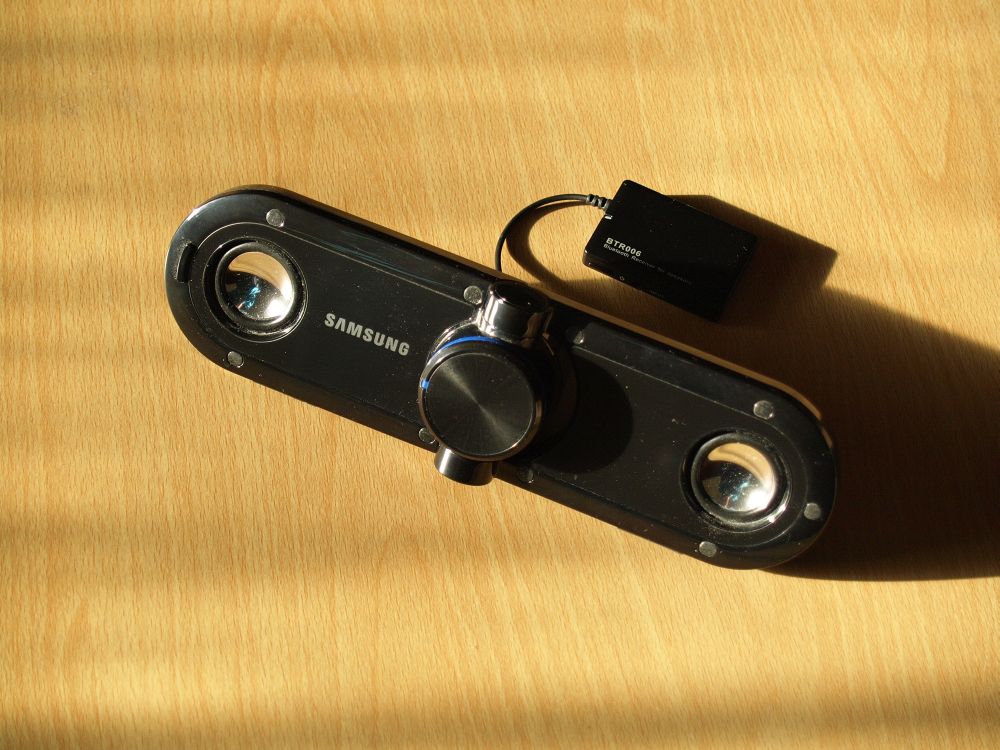
The device I use can also form the basis of a portable, rechargeable Bluetooth speaker that only cost me in total £20.  The receiver pictured above automatically pairs with my phone when I switch the Bluetooth on and I can play music either on the portable speakers or on either of my CD players or car stereo via the aux inputs.  The most impressive thing though is being able to pair it with my laptop, set up a remote control of either VLC media player or Windows Media Player via WiFi from my phone and play music from my collection via Bluetooth back to my hi-fi in the living room.  It may not be as seamless as Airplay but considering the variety of hardware it still “just works” and the sound quality is fantastic despite the music being beamed here, there and everywhere before hitting my ears.

Standard
Tech

Renting Books?

Book ChaosI have a book on my desk, The Consolations of Philosophy, it cost me £3.49 from the Oxfam bookstore, on Amazon it’s £7.36 paperback or £8.99 in the Kindle edition.  So it costs more to have it digitally sent to the Kindle app on my tablet than to have it sent through the post.

I’ve often said that I prefer paper books and for that matter CDs and DVDs because of the sense of ownership, having a physical object in my possession but a recent problem encountered by a Kindle owner illustrates how with digital media the issue of “ownership” is less clearcut.

We’ve known for years that computer software is not owned but licensed and that when you buy a book you’re only buying the medium not the content but as the story outlined by Gizmodo shows an online book or music store can, as per their terms and conditions, remove your access to what you have paid to use and the term “buy” is not strictly accurate as you already own the medium (the Kindle, Nook etc).

Recently a Norwegian woman was, for unexplained reasons, locked out of her Amazon account and as her Kindle had broken she could not reload the books she’d paid for onto a new device, it was however eventually resolved following coverage on various websites.  Amazon said that if a user’s account is closed then they still have access to the books on a device, but it appears that if you change devices you wave bye bye to “your” content.  So it’s not really “yours” at all.  Imagine if you opened up a novel you were half-way through and it had turned into an unlined notebook.  Apart from having the opportunity to write your own ending you’d be a bit miffed.

Of course you could say, as the music industry has done for years, that this prevents illegal copying, that if you lost or damaged a physical book you’d have to buy a new one, and occurrences like this are rare anyway but it highlights a question that needs answering, the industry needs to either enable access to content you’ve paid for regardless of whether you or they have closed an account and promise not to arbitrarily remove content or say up-front that what you’re getting is little more than a long-term hire agreement.

[Gizmodo UK]

Standard
Funny, Society, Tech

Pets & Passwords

christmas cats

If you’re thinking of getting your child a pet this Christmas there’s one thing you need to make sure of beyond the practicalities of its food and where it’ll sleep and whether your kids or you will end up taking it for walks (or if it’s a cat, letting it in or out of the living room/bedroom/bathroom et al).

Bizarro Comics points out the importance of giving the creature a unique, hacker-proof and, most importantly, memorable name as it will almost certainly end up as a security question some twenty years down the line.

[Bizarro Blog via Gizmodo]

Standard