Bag Fiend, Tech

Bag Fiend: King Arthur’s Messenger Bag

I haven’t bought this bag myself but the React Messenger from Travelon uses a mixture of old and new technology to protect your stuff from sticky fingers – and I don’t mean it wipes clean after someone’s been eating a doughnut.

The bag has an outer skin made from a kind of chainmail which provides a slash-proof layer while the shoulder strap is constructed with an integral cut-proofing like the Pac Safe strap that protects my DSLR.  Additionally the main compartment is kept closed by locking carabiners and the whole thing can be locked to a chair or other more immovable object of your choice.

Perfect for protecting your precious tech and/or secret government documents.  Just don’t leave it on a train or somewhere.

[Travelon via Gizmodo UK]

Standard
Architecture, Cars, Design, Health, Jubilee Britain, Meta, Psychology, Tech, Transport, Typography

Old is the New… New

Alfa Romeo Duetto

Alfa Romeo Duetto (Photo credit: lewong2000)

It seems that the more we step forward into the blinding light of our techno future the more people seem to be looking back.  Retro is still with us and is increasingly seen as a mainstream design choice.  As I see it the reasons are varied and often depend on the product.

For some the appeal of retro design comes from the feeling that designs from the fifties and sixties were crafted with more care and solidity, with metal rather than plastic, with levers and cranks that moved with a reassuring smoothness, clicked and whirred precisely giving a sense that they’d last forever and that you were getting what you paid for.  Such is the case with cameras such as Digital Leica rangefinders that remain true to their film predecessors’ styling and construction; Fujifilm’s X100, X1 and X-Pro1 cameras which are also built from metals and leather patterned plastic; and my favourite the Olympus OM-D E-M5 digital system camera which from most angles looks as solid, sleek and minimalist as the old OM series cameras – it’s only round the back that you see the array of buttons and the large screen that betray it’s 21st Century innards.  It is true that these cameras are relatively expensive and for many that will be the reason they’ll buy them but there is also another reason for products like these: to look longingly at what is often perceived as a better time in society as well as manufacturing.

Many retro products aim squarely at a time before bling when cool meant understated presence, celebrities and celebrity photographers used Leicas, drove E-type Jags and Alfa Duettos – the latter cars also currently being reborn with new century tech and tweaked, sharper lines to again bridge the gap between the past and the future.  There are hints of the rejection of overt showiness and loud celeb culture beginning to emerge.  In fashion and advertising the likes of TV shows such as Mad Men are having an effect for the same reason.  Stella Artois’ current campaigns have an obvious fifties-sixties style to associate the brand with what is seen as classic cool.

Instagram and Hipstamatic photos flood daily into Facebook and while the low-fi style of these is fun and interesting too many of the people taking the shots take the whole thing too seriously telling people that their pictures are more “authentic” because they look like old photos taken with film cameras, this kind of retro though is not strictly accurate though as film hasn’t had the kind of graininess and vignetting applied by these apps for most of the last fifty years, unless you had a really cheap camera, like the ones that you can now buy imitations of to deliberately get the poor quality – because it looks cool, of course.

So retro is either a desire to emulate a seemingly better time before our throwaway society and our transient carbon-copy celebrities, or it’s a fad to show how unconventional you are, or it’s a way to say how well off and tasteful you are, or it’s a case of designers taking cues from a time where form and function both mattered and subtlety had more impact than in-your-face showiness to create something truly stylish and often beautiful.

To create the future it is often useful to reference the past, both for its mistakes and its triumphs.

Standard
Tech

Declining Writing

We have a paperless office but I still have my...

(Photo credit: Arvid)

The paperless office is still a way off for many companies, at ours we produce invoices, jobsheets, delivery notes and of course orders, most of which I still write out, by hand on paper with a Parker Slinger pen that hangs round my neck like some kind of modern silver and lime talisman (though it is really there so I don’t forget where I’ve put it down, and also so nobody wanders off with it).

At home too I write, between me and my monitor right now is a notepad that I scribble things on when the computer’s not on or if I really need to remember them.  Like many people I find that the act of physically writing something down helps with processing and remembering the information.

It seems though that, according to online stationer Docmail that I’m becoming part of a minority.  In a survey they found that on average people, on average, wrote only every 41 days.  One in three only wrote something once in six months – usually along the lines of “Happy Birthday, lots of love xxx”.  Possibly even with a smiley face to make it feel a bit more like Twitter or Facebook.  LOL.

Saving paper is one thing, though much paper comes from renewable and recycled sources today, but could people one day actually lose or not even bother to learn how to communicate text without a computer?  Perhaps only if technology becomes so ubiquitous and user-friendly that you could replace every use of pen and paper, right down to the scribble pad by the bed that you use to jot down the thought you had just after you switched out the light.  Until then my extensive collection of pens is safe.

[Gizmodo UK]

Standard
Science, Tech

I’ve Seen The Future And… It Likes Cats

Cat bliss

Cat bliss (Photo credit: @Doug88888)

People have for many years worried about computers and robots becoming self-aware and somehow overthrowing us but it seems perhaps we don’t need to be quite so concerned; our weapon in ensuring that the global hypercomputer grows up to be nice?  Cats.

Ok, bit of an exaggeration.  We’ll need more than cats.

But anyway, Google have again created something impressive in its research labs; a virtual neural network that turned out to be like a simplified version of the human visual cortex and when it was presented with a data set consisting of images from YouTube it decided, with no training or input from programmers, to learn how to identify and define a cat and was able to generate an image of a cat based on general features.  The result is influenced by our love of filming our feline friends and sharing their antics with the world but is still a great achievement in the field.

In the future computers based on virtual neural network type structures like this would be able to intelligently search and process the vast stores of information we have and will continue to pour onto the internet.  Look forward to the day when you ask your computer for directions to Bedford and it replies “later, can’t you see I’m having a really bad day”.

[Gizmodo UK]

It should be noted here and now that I reserve the right to use a cat picture to illustrate any article on this blog where there is even a vague relevance.

Standard
Science, Society, Tech

Cataloguing The World

English: A Google Street View Camera Car (2008...

English: A Google Street View Camera Car (2008 Subaru Impreza Five Door) showcased on Google campus in Mountain View, CA, USA. taken by myself [User:Kowloonese] using a Canon digital camera. The picture was taken on Google Campus in Mountain View, CA, USA. Release for Public Domain. Kowloonese (talk) 04:53, 18 November 2010 (UTC) (Photo credit: Wikipedia)

The world is big, lots of land, rivers, seas.  Our history is vast too.  The internet contains ever growing volumes of information about both.  And videos of kittens.

Search engines help with finding things on the internet of course, and even the history part as more historical documents are digitized and more history is recorded digitally, whether it be art, music, myth and legend or epic tales.

Google though continues to go beyond its core business, using search ad revenues to actually benefit people – providing free services such as YouTube (which it bought in 2006), Google Translate, Google Docs, Google Maps and so on – which are also available from Microsoft and other providers too – as well as the Android operating system which in its Ice Cream Sandwich version (4.0) is maturing into a very nice OS.  Then there’s the suite of desktop apps including Sketchup, Google Earth,  Picasa and more.  The company even looked skyward, producing Sky Map which is now an open source product.

One wonderfully useful thing Google gave us, via their fleets of cars with Johnny Five wannabees strapped to the roofs, is Street View.  It’s so useful to be able to actually see what the place you’re going to looks like, to see your route, turn by turn at street level because using our visual memory is far better that trying to remember an abstract set of directions on a top-down map alone. They even added traffic information to their Maps product recently.

Even this though was not the end as they’ve Street Viewed railway journeys, cycle routes, footpaths and walking trails and now they’re going to be photographing towpaths along rivers and canals in the UK too.  There will no doubt be privacy complaints again and parts of riversides across the country will become strangely hazy when viewed online but it will also give us more strange and funny discoveries in the images as we’ve had from the roadgoing cameras.

Another new Google project revealed this week sees the search behemoth collecting and documenting languages from around the world that are on the verge of extinction via videos, audio recordings and other documentation. The result will be presented via an interactive website.

Some people however won’t like their other announcement – a service that allows companies to track their employees’ movements via their work phones.  Well, two out of three’s not bad.

Standard
Tech, Transport

Bike and Hammer in Imperfect Harmony

Screw_Low

Screw_Low (Photo credit: Curious_Gregor)

The recently released new Apple Macbook caused a minor stir recently when iFixit took one apart and found that it was so tightly integrated that nothing could be easily repaired by an enthusiastic techie, the memory was soldered to the board, the SSD storage was custom and even the battery was glued in so if any of these failed it would be an expensive repair and in addition upgrading was out of the question.  All of this was in the name of making the laptop thinner and shinier.

The same is true of cars where less and less can be fixed or tinkered with on the nations driveways and garages start to look more like F1 pitlanes.  More and more of our world relies on modular electronics in smaller and smaller packages, sealed (often due to the complexity of their components) and the only option on failure is to replace the whole thing, repairing no longer involves a soldering iron and screwdriver but a laptop and a plug and play black box.

So it gave me some satisfaction to actually be able to get my hands dirty and fix something for a change tonight.  My bike’s rear deraileur has been playing up recently, refusing to change into higher gears.  This may have been its attempt to improve my health (pedalling faster burns more fat, apparently) or it may have been trying to make me look silly or kill me, whatever it was I needed to get it sorted – engineering’s in the family and this bit of engineering was not gonna get the better of me.

The cable was slack but not broken, but when I pushed the mechanism into the higher gears the chain became slack.  A short period of pushing the arms up and down to identify the cause of the slackness revealed an adjustment screw pointing into thin air and adjusting nothing.  A brief period of what we used to call “passive maintenance” with a hammer to realign the bracket and a new machine screw later all was tensioned again and I’m again calling the shots as to which gear I want to use.

I have a toolbox and I’m not afraid to use it.

Standard
Society, Tech

A Worldwide Audience

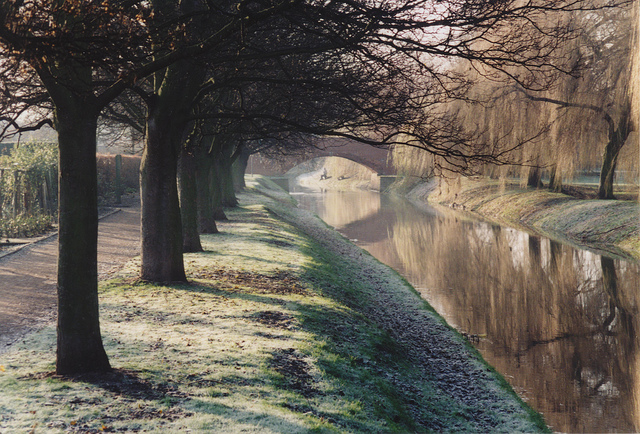
If you’d told me sixteen years ago that the photo above that I was about to take of the river through the park in Retford would have been viewed in 2012 by 55 complete strangers from various countries across the world via the internet I’d have thought you were barking.

If you’d then said that views of my photo collection would be nearly totalling 1,000 I’d have probably have just laughed.  Hysterically. Who would want to look at my pictures?

Our connected society allows creativity to be expressed as never before, new music, new books, many gems that might never have seen the light of day are unveiled and even if the audience turns out to be small for someone creating the work for the love of it, as a hobby, then just knowing that someone has appreciated it is an achievement and gives you a warm feeling inside.  I still get a buzz from seeing a spike in my Flickr views or likes on this blog.

In computing’s premillennial days the only people freely sharing things were programmers, now people upload over 72 hours of video to YouTube alone every minute.  And despite some commenters declaration that Flickr is dead in the water because it’s not a social network of the scale of Facebook it still receives thousands of uploads (2,950 in the last minute) – many of which are professionals and many are posted on camera manufacturers or magazine groups where like minded photographers can appreciate and compare each others work.

In this big yet small world there always seems to be an audience for whatever you want to say and whatever you want to show to people – whether it informs, entertains, makes them laugh, cry, scream, think or just go eurgh.

Standard
Society, Tech

Tweet, tweet, tweet, tweet, tweet, tweet

I’m not on Twitter so I don’t really know what people say apart from the odd comment reported here and there but I do know, thanks to Gizmodo UK and Cnet, that worldwide people are sending over 400 million tweets per day, 4,500 per hour.  Though apparently you can now tailor trends based on who you follow too.

Still, that’s a lot of twittering.

Standard
Jubilee Britain, Outdoors, Tech, Transport

Cycling Back

Shimano Deore XT Schaltwerk hinten (am Mountai...

(or How It’s Made – 1945 Edition)

I ride a bike to work, and enjoy cycling, the wind in your hair, well the wind in just about every part of you depending on how you’re dressed.  So it was interesting to watch this video showing how bikes were made in postwar Britain, shortly before the coronation.

[Vimeo via Gizmodo UK]

Standard
Jubilee Britain, Tech

Brittanica – Going Digital Gracefully

English: Title page of the Americanized Encycl...

English: Title page of the Americanized Encyclopedia Britannica (Photo credit: Wikipedia)

Techdirt recently reported on how a British institution adapted to the new century’s technology rather than trying to sue its competitors into oblivion or whining “that’s not fair”.

The first decade of this century has seen a massive shift to digital distribution and consumption both legally and illegally.  Some traditional media creators have reacted to this with great anger and lawsuits that would keep Ally McBeal busy for a few series (ok, showing my age there, but it was the last legal series I watched).  Instead of adapting business models to cater for these new outlets, providing exclusive tasty content or extra value with digital downloads to tempt people away from pirate sites for example, they have tried to simply legislate the problem away – hence SOPA et al.

They criticise artists who give away content for free, ignoring the facts that this can generate sales as people will often pay for foll0w up material, as also often happens after someone downloads pirated material and then buys the album after they find they like it.  As a content producer I don’t condone piracy, but I don’t feel that tighter copyright laws will help either.

Which brings me on to the venerable, weighty and very British Encyclopedia Britannica.  In the nineties a CD based publication was launched and then as that market faded they launched their own online encyclopedia in the face of the onslaught of Wikipedia and the like.  In both cases they saw what was coming early on and adapted and restructured in order to embrace and make the most of the emerging technology rather than hold on to the past.  Britannica.com is still here alongside Wikipedia because it has evolved, moved with the times and because of its history and reputation it is still a trusted source of information.  They have a premium paid-for service that provides extras for members such as videos, research tools and more.

From door-to-door to digital with no fuss, taking it all in its stride.

[Techdirt]

Standard